Ecclesiastical Organizational Charts
In spring 1830, JS
organized the Church of Christ with elders, priests, and
teachers.
Over the next five years, he developed and adapted church organization to a growing
membership, adding the offices of high priest, deacon, bishop, patriarch, apostle, and
seventy and organizing quorums, councils, presidencies, and bishoprics. The first
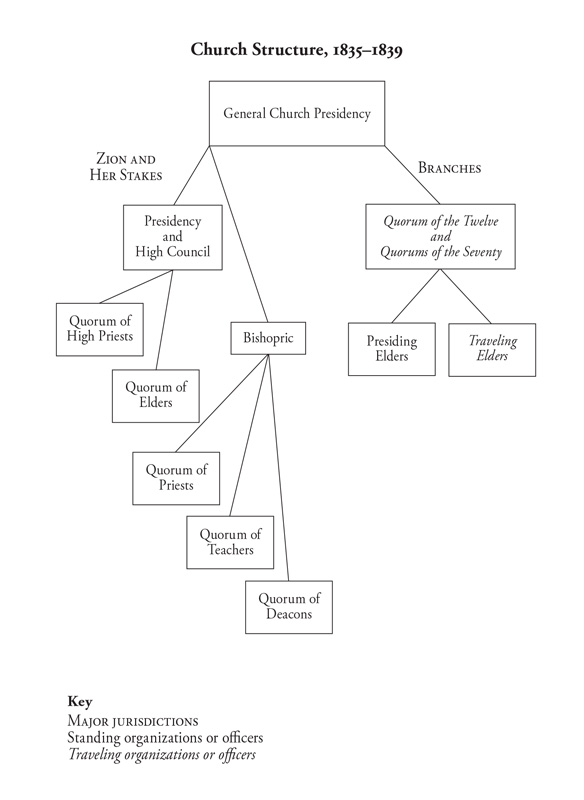
chart that appears below, titled “Church Structure, 1835–1839,” outlines the
ecclesiastical structure that emerged by 1836. The three subsequent charts supply the
names of church officers in
,
Ohio;
; and the
(later Nauvoo),
Illinois, area. They also track major changes in personnel.
Because of the constant change in church organization between 1832 and 1834—the period
covered in JS’s first journal—a chart showing officers for that period is not
supplied. During 1835–1836, the period covered in JS’s second journal, JS worked to
refine organizational structure and fully staff church positions in preparation for
the solemn assembly to be held in the
in
. The chart dated March 1836 presents the
resulting organization. The next chart, dated spring–summer 1838, approximates church
organization and officers named in JS’s two 1838
journals. The final chart, dated October
1839, reflects the early reorganization efforts that followed the Mormon exodus from
to
. It presents church organization and
leadership as it existed by the conclusion of JS’s first
journal in 1839.
Church
Presidencies and Councils
At the church’s
organization in April 1830, JS was recognized as first elder and
as second elder. On 8 March 1832, JS was
“president of the high priesthood,” and
and
were his “councellers of the ministry of the
presidency of th[e] high Pristhood.” The term “counsellor” was still used in
a revelation of 8 March 1833 designating these officers—by now
and —as being equal with JS in
holding the keys of the kingdom.
Beginning in June 1830,
JS used gatherings or “conferences” of church officers as deliberative bodies in which
to conduct the business of the church, including disciplinary proceedings. In time,
“general conferences” involving a substantial proportion of church officers were
supplemented by more frequent ad hoc, or “special,” conferences. Beginning in 1832,
the term “council” was used interchangeably with “conference” for these smaller, ad
hoc meetings. JS and his counselors played leading roles in the proceedings.
JS formalized the
practice by organizing in February 1834 at
“the high council of the
Church
of Christ,” a standing body consisting entirely of high priests.
Thereafter, the term “assistant president” was generally applied to those who had
earlier been called counselors to JS, and members of the high council were called the
presidency’s counselors, thus avoiding confusion in the use of the term
counselor. JS and his assistant presidents served
as the presidency of the high council as well as the presidency of the high priesthood
and therefore the presidency of the church. In July 1834, a similar high council was
organized in
, Missouri, which was designated the high
council for
, and JS ordained
president of the high council, with
and
as
’s “assistants,” after which JS ordained “their
twelve Counsellors”—the members of the high council.
was recognized as “President, head and leader
in
(in the absence of br. Joseph Smith jr.).”
In December 1834, JS
reorganized the church presidency, adding
as an assistant president, ranking before the
existing assistants,
and
.
JS also ordained
and
as assistant presidents.
During late 1835 and
early 1836, while members of the
presidency and most of their high council
were temporarily residing in
preparing to receive the promised endowment
of power, the configuration of church councils held in
varied. Frequently a “council of the
Presidency” met, consisting of members of both the general church presidency based in
and the
presidency from
.
When the high council was convened, it might consist of any combination of twelve
members taken from the
high council from
, the high council of the
stake of
, or the traveling high council—the Quorum of the
Twelve Apostles—with one to three members of the combined presidency serving as
presidents of the high council for that particular meeting. Further complicating the
scene, in addition to the presidencies of each high council, by 21 January 1836 one of
the twelve regular members of each high council was designated its president. On that
date,
was recognized as “the president of the
counsellors in Kirtland” and
as “the president, of the counsellors of
Zion.”
In late 1835 and early
1836, JS anticipated that he and his assistant presidents would move to
by the following spring. Regulations for the
approval of ordinations adopted in early 1836 seem to anticipate a level of
interaction between
and
church authorities that could take place only
if they remained in close proximity—and it was anticipated that this would be in
, not
.
However, the logistics of migration to
and financial entanglements in
precluded JS’s relocation that year, and the
presidency and high council of
eventually returned to
without him and other leaders who continued
to be based in
. The close working relationships, and indeed
the interrelationships of 1835–1836, therefore never materialized again.
In 1837, contending with
dissent in
and a perceived weakening of support among
some church leaders in
, JS reiterated his authority over the entire
church. His 4 September letter to Saints in
was headed “Joseph Smith Jr. Prest of the Church of Christ of Latter Day Saints in all the world.” It also
applied the term “first Presidency” to the presidency of the church who were then
located at
. This was not a new position or
assertion of authority for JS but clarified arrangements that may have seemed
ambiguous. Some may have misinterpreted the earlier configuration of presidencies as a
decentralized leadership with one presidency responsible for each of the church’s two
main divisions,
and
. JS’s reassertion of churchwide leadership caused
Hepzibah Richards to write from
in January 1838 that “the presidents, Joseph
& Sidney & Hiram returned from Missouri a few weeks since. They are elected to
the first presidency, or to preside over all the churches instead of this place
only.” The term “first presidency,” first used
officially in 1834, came into more general use during 1838 and eventually supplanted
other nomenclature.
The September 1837
conference documents a transition in terminology and organization. In
in September, JS as president and
and
as his counselors constituted
“the three first presidnts of the Church.”
,
,
, and
were now “assistant Councillors,” and the seven
were “to be concidered the heads of the Church.” After this conference, use of
the titles “assistant president” and “assistant counselor” diminished. The last known
use of “assistant” in connection with the First Presidency during JS’s lifetime was
the temporary appointment of
as assistant president in
, 1841.
Church Structure, 1835–1839
March
1836
During the period
covered in his 1835–1836 journal, JS worked to fully organize the priesthood units in
preparation for the solemn assembly that was held in the
in
, Ohio, on 30 March 1836. This organizational
effort included staffing each quorum, council, or presidency; organizing each quorum
with a presidency; and clarifying relations among groups.
General Church Officers
| Presidency | Patriarch |
| Joseph Smith Jr., president | |
| , assistant president | |
| , assistant president | |
| , assistant president | |
| , assistant president | |
| , assistant president | |
| During the period in which officers were in awaiting the solemn assembly, the general church presidency (based in ) and the church presidency often functioned as a general presiding council, to which JS referred as “my council of the presidency” or, more commonly, as simply “the presidency” or “the presidents.” This council of nine men or an available subset functioned in as a presiding council until the presidency returned to its local jurisdiction. |
Other Officers
| (Clay County, Missouri) Officers | |
| The Latter-day Saints, having been driven from their homes in , were living primarily in in March 1836. | |
| Presidency | Bishopric |
| , president | , bishop |
| , assistant president | , counselor |
| , assistant president | , counselor |
| High Council | President of Quorum of Teachers |
| The high council apparently retained its original order, based on the 7 July 1834 casting of lots, with replacement members taking the number of their predecessors. Although was the president of the council in March 1836, he was still listed among the other members with his original number. | George Johnson |
| No evidence has been found of additonal quorums functioning in at this time. | |
| , president | |
| Stake Officers | |
| Presidency | Presidency of Quorum of High Priests |
| The presidency of the church presided over the stake and its high council. | , president |
| High Council | Unidentified counselors |
| , president | Presidency of Quorum of Elders |
| , president | |
| , counselor | |
| , counselor | |
| Presidency of Quorum of Priests | |
| , president | |
| Unidentified counselors | |
| Presidency of Quorum of Teachers | |
| , president | |
| Unidentified counselors | |
| Presidency of Quorum of Deacons | |
| , president | |
| Bishopric | Unidentified counselors |
| , bishop | |
| , counselor | |
| , counselor | |
| Traveling Officers | |
| Quorum of the Twelve | Quorum of the Seventy, Presidents |
| Listed in order of seniority—that is, age at time of appointment of the original Twelve. | The presidents of the Seventy presided over the Quorum of the Seventy. The presidents were apparently ordered by seniority of age. |
| , president | |
Spring–Summer 1838
In the two years between
spring 1836 and summer 1838, there were substantial changes in church leadership, the
result of two principal factors. First, in response to dissent among church leaders in
late 1837 and early 1838, JS oversaw or approved the removal and replacement of
several officers. Second, other officers in
, Ohio, followed JS in migrating to
in 1838. Some but not all
officers were replaced. A few leaders stayed
behind to oversee stake matters, while most loyal
Latter-day
Saints prepared to move to
. As
, Missouri, filled with Latter-day Saints,
immigration was steered northward to
, Daviess County, Missouri, where a
stake was organized on 28 June 1838.
General Church Officers
| First Presidency | Patriarch |
| Joseph Smith Jr., president | |
| , counselor | |
| , counselor | |
| , assistant counselor | |
| , assistant counselor | |
| During a church conference held in in September 1837, JS presented , , and himself as “the three first presidnts of the Church.” He then presented , , , and as “assistant Councillors.” In a conference held in two months later, was removed and replaced by . The assistant counselors were not presented for sustaining at this conference, and they were not again presented as such. |
Other Officers
| (Far West, Missouri) Officers | |
| Presidency (Pro Tempore) | Patriarch |
| , president | |
| , counselor | Bishopric |
| , counselor | , bishop |
| High Council | , counselor |
| , counselor | |
| President of Quorum of High Priests | |
| President of Quorum of Elders | |
| President of Quorum of Priests | |
| As bishop, presided over the quorum of priests. | |
| President of Quorum of Teachers | |
| President of Quorum of Deacons | |
| Unidentified | |
| , president | |
| Stake Officers | |
| After JS’s departure from on 12 January 1838, a few leaders stayed behind to oversee stake matters while loyal Latter-day Saints prepared to move to . | |
| Presidency | President of Quorum of High Priests |
| , president | Hiram Kellogg |
| , counselor | Presidency of Quorum of Elders |
| , counselor | , president |
| Bishop | Hezekiah Fisk, counselor |
| Lahasa Hollister, counselor | |
| Stake Officers | |
| Presidency | High Council |
| , president | Listed in the order given at the time of the council’s initial organization. It is unclear whether there was an established order of counselors in the high council. |
| , counselor | John Lemon |
| , counselor | |
| Bishop (Pro Tempore) | |
| Isaac Perry | |
| Traveling Officers | |
| Quorum of the Twelve | Quorum of the Seventy, Presidents |
| Quorum members held seniority according to age. | The presidents of the Quorum of the Seventy were reorganized in April 1837 amid confusion over the relationship between high priests and seventies. Presidents of the Seventy who had been previously ordained high priests were reassigned to the high priests quorum, and new presidents of the Seventy were appointed to replace the outgoing high priests. At its initial organization, the presidents of the Quorum of Seventy held seniority according to age; when the presidency was reorganized, new presidents assumed the level of seniority of the outgoing high priests. The presidents presided over three quorums of Seventy. |
| , president | |
| Quorum members , , , and had been excommunicated. An 8 July 1838 revelation appointed , , , and to replace the former quorum members, but none were ordained to office before December 1838. | |
October
1839
Following their
forced expulsion from
in spring 1839, the Latter-day Saints
regrouped in
. After JS’s escape from incarceration in
April 1839, he began to reorganize the Latter-day Saints at
(later Nauvoo), Illinois, and across the
river in
. Banished from the land they considered
,
the Latter-day Saints denominated
, now the central church unit, a “stake” like
other major church units.
General Church Officers
| First Presidency | Patriarch |
| Joseph Smith Jr., president | |
| , counselor | |
| , counselor |
Other Officers
| Stake Officers | |
| President | Bishops |
| , Middle Ward | |
| High Council | , Upper Ward |
| Listed in order of seniority as noted in the minutes of the high council. | , Lower Ward |
| , president | President of Quorum of High Priests |
| Stake Officers | |
| Presidency | |
| , president | |
| , counselor | Richard Howard |
| , counselor | |
| High Council | |
| Listed in the order established by drawing lots at the council’s initial organization. | |
| Bishop | |
| John Patten | |
| Traveling Officers | |
| Quorum of the Twelve | Presidents of the Seventy |
| The original members continued in their age-based seniority; newer members followed, ordered by age amongst themselves. On 16 January 1839, the First Presidency instructed and to appoint the oldest of the original members to be president of the quorum. was sustained as president on 14 April 1840. | The presidents of the Seventy presided over three quorums of Seventy and a number of seventy not assigned to a specific quorum. It is unclear whether there was an established order of seniority among the presidents. |
| , president | |
| A July 1838 revelation appointed , , , and to replace excommunicated quorum members , , , and . and were ordained 19 December 1838. was ordained 26 April 1839, as was , the latter filling the vacancy left by the apostasy of . , still proselytizing in , was not ordained until 14 April 1840. By this time, had been killed in the conflicts and had apostatized, as noted above, with , who soon returned to the church. A conference held near , Illinois, on 4 May 1839 resolved that the apostolic privileges of and be “suspended” until the next church conference, at which time they would be allowed to give an account of their conduct. Both were “restored” to their offices at a conference held in October 1839. The quorum reached a full contingent of twelve men with the appointment of in 1841. | |